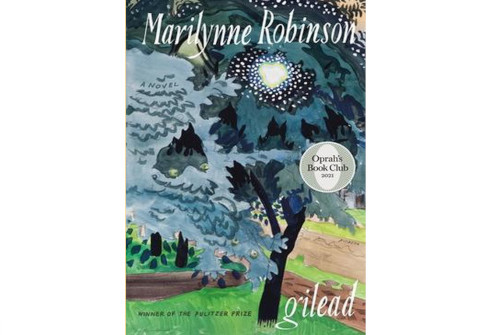
Gilead – Marilynne Robinson
Deze Engelstalige gastrecensie is geschreven door Maryse Klück.
Christianity, Tenderness, and Parental Love: A Book Review of Marilynne Robinson’s Gilead
Gilead is a book that I stumbled upon by pure chance. I entered a second-hand bookshop (AKA a goldmine for classics), following a hunch. Usually I enter a bookshop with an idea of what I want to read- something about mythology, or a classic piece of literature like Precious Bane or Far From the Madding Crowd. This visit, however, was me purely following a whim.
The right book will choose you
It may sound too metaphysical, but I believe that the right book will choose you. It’s not so much the reader selecting his or her books, but the other way around. It’s like in Harry Potter and the Philosopher’s Stone: ‘the wand chooses the wizard’. There are genuinely beautiful pieces of classical literature out there that I simply don’t resonate with, that don’t leap into my hands when I take them off the shelf in a bookshop. A book, I think, is a little piece of your soul, because when you love it, it resonates with the deepest fibre of your being.
Such a book is Gilead by Marilynne Robinson. Its lyrical prose, observations on Christianity, mankind, and humanity- these are things I love to read about. I remember going through a little basket in that second-hand bookshop, feeling slightly demotivated. I had been in a reading slump for quite a while, and then, all of a sudden, I had Gilead in my hands and was flipping through it, falling in love with its elaborate sentences and tender depictions of family and friends.
Uplifting character
Gilead is set in 1956, in America. Our main character, Reverend John Ames, is aware that he’s reaching the end of his life, and he’s writing letters to his young son. Despite the fact that death overshadows the book like a stealthy side-character waiting to pop up, this is far from a miserable or depressing book. It’s uplifting. Ames has no fear of death, being a devout Christian, and his only concern is that his wife and son shall be poor when he’s gone. He also loves his family, and therefore isn’t too keen on leaving them. Nonetheless, Reverend Ames is fearless. His quiet bravery permeates the entirety of the book.
Something that struck me about Ames is that he’s a likeable character who is as good as he is interesting, which is rare in fiction. Many works of fiction feature characters who are intense, difficult, unpleasant, overly charismatic, and/or immoral: look at Catherine Earnshaw and her diabolical lover Heathcliff from Wuthering Heights. Mr Rochester from Jane Eyre isn’t a full-out evil man, but he does, at first, deceive Jane into a false marriage. So, he isn’t good either. Bathesheba Everdeen from Far From the Madding Crowd is an arrogant lady, who steps into one blunder after the other, and Viktor Frankenstein is a walking, talking bundle of narcissism. My reading slump (which I have promptly entered again after having finished Elizabeth Goudge’s The Little White Horse) had a lot to do with the fact that great works of literature don’t often feature nice people.
Plots seem to revolve on deeply flawed people and their toils, especially 19th century English literature, and at one point one gets tired of it. Perhaps Milton’s depiction of Satan in Paradise Lost started the trend of writing about unpleasant antiheroes, due to the psychological intrigue they pose. Be that as it may, I’m rather tired of reading about nasty people and their woes, so Gilead was a welcome change to that. Ames’ good character is lauded in the praise for the book. The Financial Times has written that ‘Ames is that rarity in fiction, a thoroughly good man. Yet he remains interesting.’ This quote is one of the reasons why I picked up Gilead.
Gilead: its ability to reflect on humanity
Something else that makes Gilead special is its ability to reflect on humanity, and to hold deep conversations with the reader. I’m not too fond of modern literature because often it tends to be a bit superficial, preoccupied with making some mandatory political statement to appease (or aggravate) the readers. Gilead is the opposite of that. The only political statement (and an important one!) is Ames’ depiction of the American Civil War, and how his Abolitionist grandfather fought on the side of the Unionists to liberate oppressed slaves. But that’s about it.
Even though Ames is a preacher (and Robinson a Christian writer), his depiction of his faith is never preachy or irritating. It is profound and wise, appealing even, I think, to non-Christian readers. Take, for example, this beautiful passage:
The moon looks wonderful in this warm evening light, just as a candle flame looks beautiful in the light of morning. Light within light. It seems like a metaphor for something…it seems to me to be a metaphor for the human soul, the singular light within the great general light of existence. Or it seems like poetry within language. Or marriage within friendship and love.
Family
Ames’ love for his family is another central theme in the book. As I said before, Ames is not afraid of dying- he is afraid of leaving his beloved wife and son. It’s quite rare to come across a fictional family that’s not at odds with one another. Literature seems to thrive on some sort of conflict, but Gilead does not. And that is its charm. Ames stresses the importance of parents honouring their child, just as the child honours his or her parents, and describes the beauty of parental love.
Your mother could not love you more or take greater pride in you. She has watched every moment of your life, almost, and she loves you as God does, to the marrow of your bones. So that is the honouring of the child. You see how godlike it is to love the being of someone. Your existence is a delight to us.
Such words bring tears to my eyes, because it is so gentle, so soft. The ability to write about tender things is also something that is lacking in literature these days- in my not so humble opinion.
Heartwarming books
My favourite books, ranging from Mary Webb’s Precious Bane (which I can’t stop writing about on my website and Substack) to The Lord of the Rings to Gilead all have moments of softness and tenderness in them. Yes, even The Lord of the Rings, despite the battles and wars in there. Sweetness and kindness is an underestimated virtue and theme in books. When I enter a bookshop, so many books that I see are about dark and problematic themes. Crime. Horror. Family troubles. Broken hearts. An evil secret. I’m not even checking out the romantasy section because the amount of toxic romances in there are overwhelming. That is why I’m so delighted and deeply in love with a book when tenderness and amiableness are themes.
Gilead is a must-read especially now
In this era of polarisation, division, and political extremism, we need books like Gilead. We need a book that reminds us of the softness that lies within our hearts, that our humanity lies not in our talents for destruction, but in our capability to love and be loved.
 Previous Post
 Next Post